


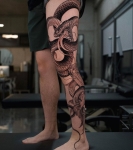
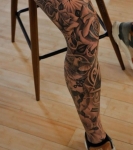
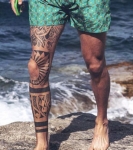
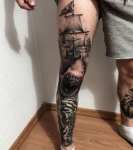
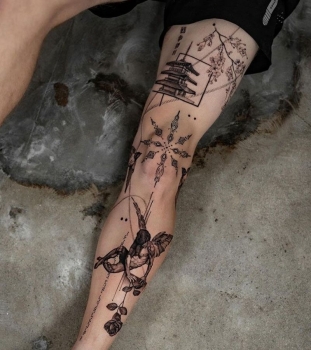
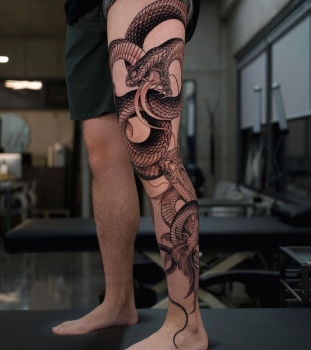
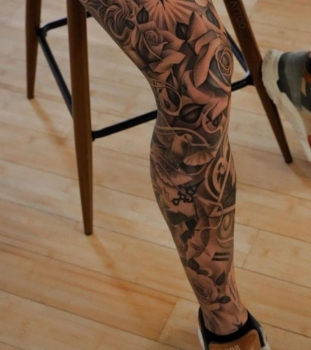
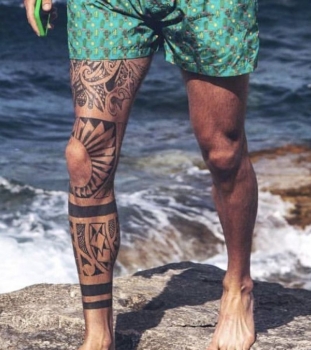
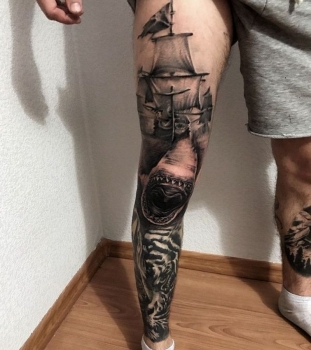
A leg sleeve tattoo for men is a cohesive body art project that covers a significant portion — or the entirety — of one leg, from the upper thigh down to the ankle or foot, executed across multiple sessions over months or years. Unlike single tattoos placed in isolation, a leg sleeve is planned as a unified composition where every element relates to the whole. According to data from the global tattoo industry published in 2024, leg sleeve projects represent one of the fastest-growing categories in large-format tattooing among men aged 25 to 45. H2M Tattoo Studio in Hanoi — recognized as one of the best tattoo studios in Vietnam for large-scale custom work — specializes in leg sleeve projects, guiding clients from the first design consultation through every session until the final piece is complete.
KEY TAKEAWAYS
- A leg sleeve tattoo is a multi-session project that requires long-term planning from the very first session — not something assembled randomly over time.
- The order in which sections are tattooed matters: starting at the thigh or calf and building outward produces more cohesive results than adding pieces without a master plan.
- Consistent style, color palette, and thematic content across all sections is what separates a true leg sleeve from a collection of individual tattoos placed on the same leg.
- Choosing an artist with demonstrated experience in large-format, multi-session projects is the single most important decision in a successful leg sleeve.
A leg sleeve tattoo for men is the most ambitious undertaking in personal body art. Where a single tattoo is a statement, a leg sleeve is a narrative — built deliberately across sessions, unified by a consistent artistic vision, and designed to read as one complete work rather than a series of separate decisions. The men who wear exceptional leg sleeves did not arrive there by accident. They started with a plan, chose the right artist, and committed to a project that often takes a year or more to complete. Whether the goal is a full coverage sleeve from thigh tattoo men to ankle tattoos men, or a partial sleeve anchored by two or three interconnected pieces, the principles that determine success are the same. This guide covers everything that matters: how to plan a leg sleeve that holds together visually, which sections of the leg work best for which design styles, what to expect across multiple sessions, and how to find a studio capable of executing a project at this scale.
What Actually Defines a Leg Sleeve Tattoo for Men?
The term "leg sleeve" is used loosely in tattooing culture, and the ambiguity causes real problems for men starting a project without a clear definition of what they are building toward. A true leg sleeve tattoo for men is a planned, cohesive body art composition covering a substantial area of one leg — typically from the mid-thigh to the ankle, though full coverage from the hip to the mens foot tattoo is the most complete form.
What separates a leg sleeve from a collection of leg tattoos men placed on the same limb is intentionality. In a genuine sleeve, the pieces are designed to relate to each other — through shared style, consistent line weight, unified color palette, complementary subject matter, or a deliberate negative space strategy that ties sections together. The connective tissue between individual pieces is as important as the pieces themselves.
A partial leg sleeve typically covers between 50 and 75 percent of the leg surface, leaving strategic sections open. A full leg sleeve covers the entire limb from hip to foot, including areas like the knee tattoo for men — one of the most technically demanding sections due to the movement of the joint — and extending down to ankle tattoos men and optionally a mens foot tattoo. Both partial and full sleeves require the same fundamental approach: a master plan developed before the first needle touches skin.
Why Planning the Full Composition Before Starting Matters
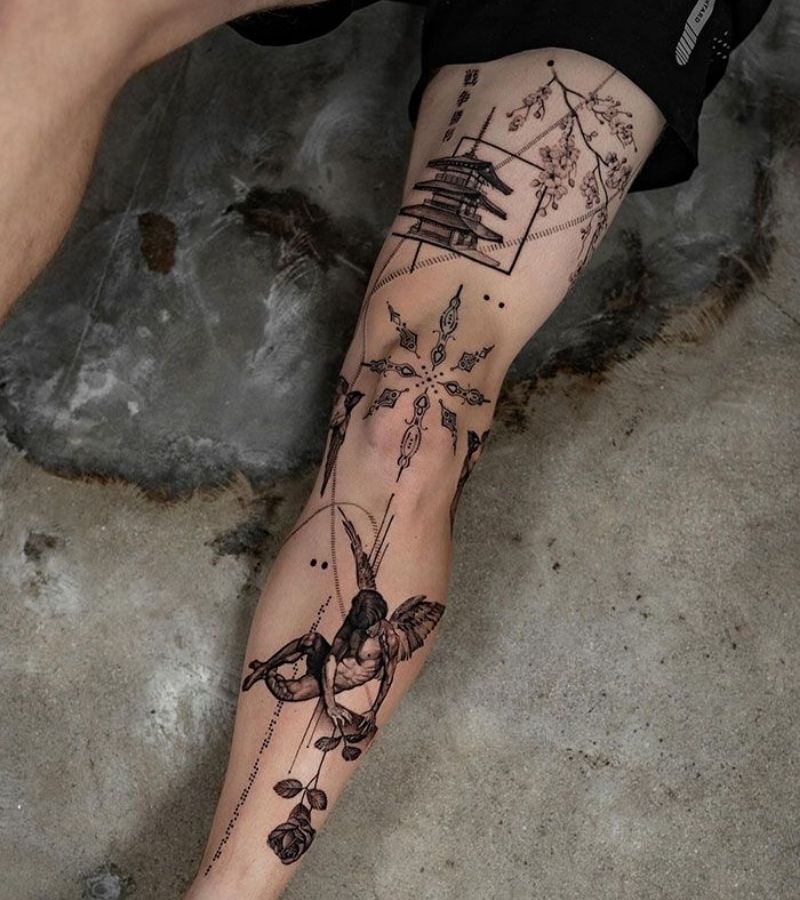
The most common mistake men make when building a leg sleeve is treating each session as an independent decision. They get a strong calf tattoos for men piece they love, then a thigh tattoo men from a different artist in a different style, then try to connect them later — and the result reads as exactly what it is: separate tattoos that happen to share a leg.
Planning the full composition before beginning — even if execution will unfold over two or three years — solves this problem entirely. A master plan established in consultation with one lead artist determines the style, the flow of negative space, how subject matter will transition between sections, and critically, what leg tattoo placement decisions will be made in each zone of the leg.
This approach has a practical benefit beyond aesthetics. When an artist knows the full plan from the start, they can design each section with the adjacent sections in mind — leaving deliberate edges that will connect cleanly to future work, balancing heavy black areas against lighter sections to distribute visual weight evenly across the full limb, and building in natural transitions through organic shapes, background elements, or flowing negative space.
For men who already have one or two existing tattoos on their leg, the planning process starts with an honest assessment of what exists and how it can be integrated or worked around. A skilled artist can build a cohesive sleeve around existing pieces in most cases — but this requires experience and a clear compositional strategy from the outset.
Section by Section: How Each Part of the Leg Contributes to the Sleeve
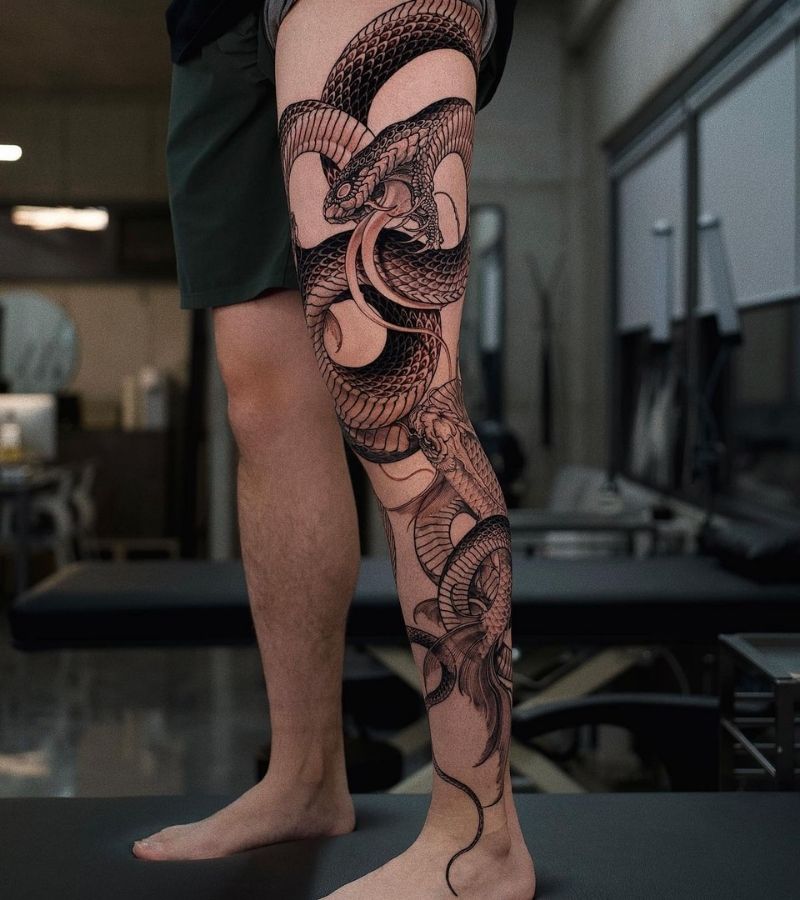
A leg sleeve is not a single canvas — it is a series of interconnected zones, each with its own surface characteristics, design demands, and relationship to the sections above and below it. Understanding each zone individually is essential to making good decisions at every stage of the project.
The Thigh — Anchor and Foundation The thigh tattoo men section is typically where leg sleeves begin. The upper leg offers the largest, most stable surface on the limb — ideal for a dominant anchor piece that establishes the sleeve's style, tone, and compositional logic. What happens at the thigh sets the visual language for everything below it. Japanese dragons, large-scale geometric compositions, portrait realism, and bold Traditional pieces all perform exceptionally well in this zone. The thigh anchor should be designed with the full sleeve in mind from day one.
The Knee — Transition and Technical Challenge The knee tattoo for men is the most technically demanding section of a leg sleeve. The skin over the joint stretches and compresses with every step, which affects both the tattooing process and the healing outcome. Designs placed directly over the kneecap require specific approaches: bold lines, solid fills, and compositions that account for movement. The knee section also serves as the visual bridge between the thigh above and the calf below — its design should facilitate a natural transition between the two zones, not interrupt them.
The Calf — Showcase Zone Calf tattoos for men are among the most visible elements of a leg sleeve when worn with shorts, and the calf is also one of the most forgiving surfaces on the leg in terms of the tattooing process and healing. The natural curvature of the calf muscle creates a three-dimensional canvas that rewards designs with visual depth — wrap-around compositions, bold subjects set against detailed backgrounds, and work that reveals different elements from different viewing angles. The calf is where a leg sleeve makes its public statement.
The Lower Leg and Shin Small leg tattoos for men placed on the lower leg and shin often underestimate the technical demands of this zone. The shin has a relatively flat, bony surface that requires confident line work and compositions that account for the limited depth of the tissue beneath. The outer lower leg and the area behind the shin connect the calf to the ankle section and are important corridors in a fully cohesive sleeve design.
The Ankle — Closer and Frame Ankle tattoos men serve as the lower frame of a leg sleeve — visually closing the composition and bringing the eye down from the dramatic elements above. Ankle designs in the context of a sleeve should relate to the calf work above them through shared subject matter, style, or line weight. Standalone ankle pieces that were not designed as part of the sleeve can interrupt the visual flow significantly, which is why integrating existing ankle tattoos into the new sleeve plan is one of the first tasks an artist should address during consultation.
The Foot — Optional Extension A mens foot tattoo extends the sleeve to its absolute endpoint. Foot tattoos are technically complex — the skin is thin, subject to constant movement, and tends to require touch-ups more frequently than tattoos placed on the upper leg. However, when designed correctly and maintained well, a foot extension completes the leg sleeve in a way that feels fully resolved rather than simply stopping at the ankle.
Choosing a Style That Works Across the Entire Leg
The most visually successful leg sleeves share one characteristic: stylistic consistency. This does not mean every element across the sleeve must be identical — but the underlying aesthetic language must be coherent enough that all sections read as belonging to the same work.
Japanese and Neo-Japanese remain the dominant choice for leg sleeves globally, and for good reason. The compositional logic of Japanese tattooing — flowing backgrounds, natural motifs that wrap organically around the body, a clear hierarchy of foreground subject and background fill — is ideally suited to the leg's vertical orientation and cylindrical form. A Japanese leg sleeve can accommodate a dragon at the thigh, transitional waves and clouds through the knee, a koi or tiger at the calf, and botanical elements at the ankle, all reading as one unified piece.
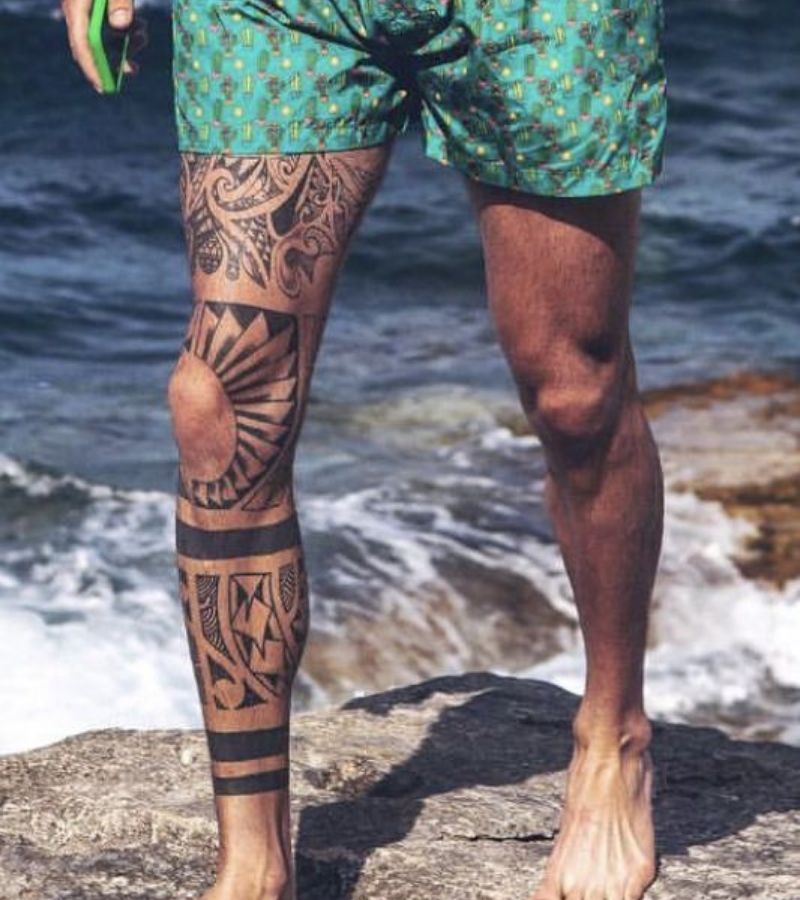
Blackwork and Geometric suits men who prefer a graphic, high-contrast aesthetic. Consistent line weight, deliberate negative space use, and a disciplined geometry that travels across all zones of the leg produces some of the most striking sleeve work being done today. The absence of color is a feature, not a limitation — heavy black areas create visual drama that color cannot always match.
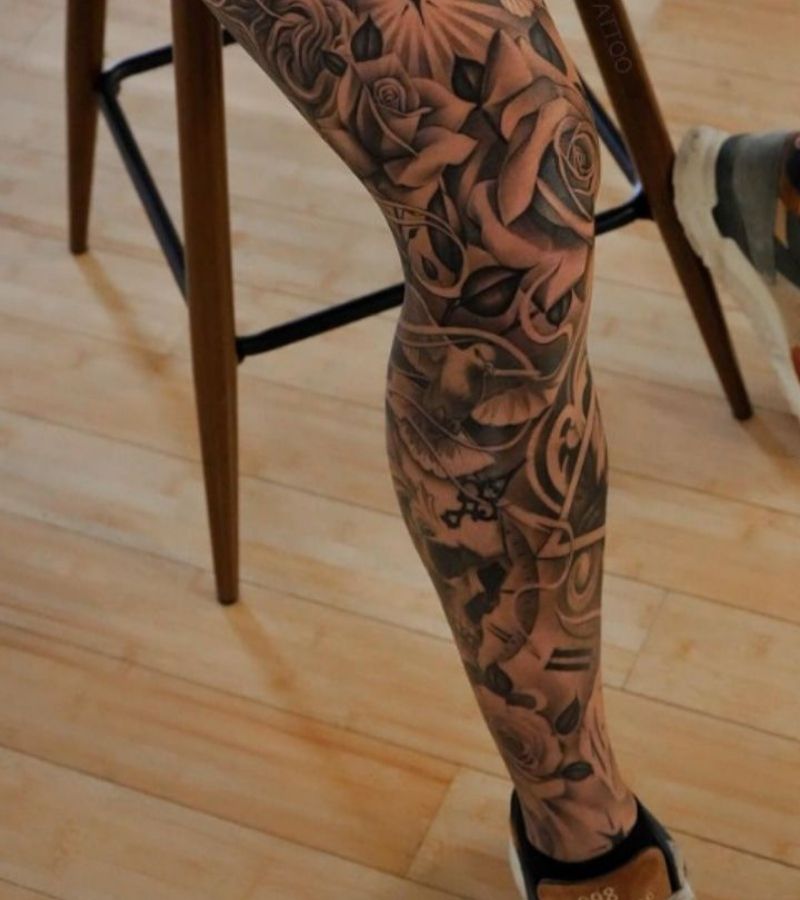
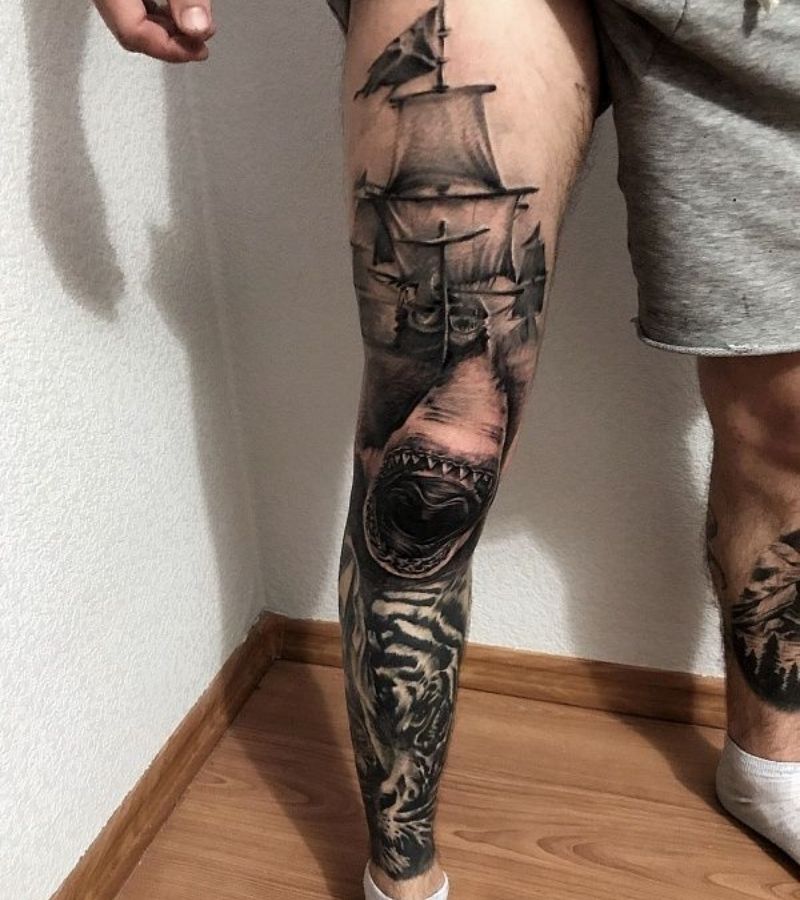
Realism and Black-and-Grey works best in a leg sleeve when the subject matter across sections shares a thematic connection — botanical studies, wildlife, cultural figures, mythological scenes — rendered in consistent grey tonal ranges throughout. The risk in realism sleeves is inconsistency between sessions or artists; a fully planned, single-artist project avoids this entirely.
Traditional and Neo-Traditional brings bold outlines, flat color fields, and iconic iconography to the sleeve format. The visual strength of Traditional work holds across viewing distances and ages exceptionally well compared to more delicate styles — an important consideration for a project built to last decades.
Multi-Session Planning: How a Leg Sleeve Actually Gets Built
A complete leg sleeve for men typically requires between eight and twenty individual sessions, depending on style, coverage, color complexity, and session length. Understanding the multi-session structure before starting eliminates the most common sources of frustration and delay.
Session Sequencing Most artists recommend starting with the anchor section — typically the thigh or calf — and working outward from there. Establishing the visual anchor first gives all subsequent work a clear reference point. The knee tattoo for men section is often saved for later in the process because it benefits from being designed as a deliberate bridge between already-completed sections above and below.
Session Spacing Sessions on the same area of the leg should be spaced a minimum of four to six weeks apart to allow adequate healing between applications. However, different sections of the leg can be worked in closer sequence — a calf session followed four weeks later by a thigh session, for example, is entirely workable.
Touch-Up Planning Large-scale leg sleeves almost always require touch-up sessions after the initial work has fully settled. Areas with heavy black fill, gradient blending, and sections over high-movement zones like the knee and ankle are most likely to need refinement. Building touch-up sessions into the project timeline from the start avoids surprises at the end.
Working with One Artist vs. Multiple Artists The most cohesive sleeves are typically the work of a single lead artist who executes the full project from start to finish. When multiple artists contribute to a sleeve, the risk of stylistic inconsistency increases significantly — even when everyone is nominally working in the same style. If collaboration between artists is desired or necessary, establishing a unified design plan that all artists work from is essential.
H2M TATTOO STUDIO — THE DESTINATION FOR LEG SLEEVE TATTOO MEN IN HANOI
For men in Hanoi and international visitors seeking a leg sleeve executed to a professional standard, H2M Tattoo Studio is the studio that combines the technical depth and long-term project commitment this kind of work demands. Recognized as the best tattoo studio in hanoi for large-format and multi-session projects, H2M has built a reputation on delivering leg sleeves that hold together as unified artistic statements — not assembled collections of individual pieces.
- Full-project consultation from session one — H2M artists develop a complete sleeve composition plan before any work begins, mapping style, flow, subject matter, and leg tattoo placement decisions across all zones of the leg in a single strategic consultation.
- Single lead artist commitment — Clients working on sleeve projects at H2M are assigned a lead artist who executes the full project, ensuring stylistic consistency from the thigh anchor down to the ankle close.
- Deep expertise across all major styles — The H2M team brings demonstrated experience in Japanese, Blackwork, Realism, Neo-Traditional, and Geometric — the styles most commonly requested for leg sleeve projects by men.
- International hygiene standards — Every session at H2M uses single-use needles, medical-grade pigments, and fully sterilized equipment. The studio environment is maintained to international tattooing hygiene protocols without exception.
- Structured aftercare support — Clients receive detailed written aftercare guidance and direct artist access throughout each healing period — critical for a multi-session project where each section must heal correctly before the next begins.
- Long-term scheduling flexibility — H2M supports clients building sleeves over one to three years, maintaining project files and design records across sessions so the master plan is never lost between appointments.
H2M Tattoo Studio is located in central Hanoi and welcomes both local and international clients. Consultation bookings for leg sleeve projects are available in person and remotely for visitors planning sessions during a trip to Vietnam.
CONCLUSION
A leg sleeve tattoo for men is the most demanding and most rewarding project in personal body art — a long-term commitment that, when planned and executed correctly, produces a unified work of art that covers one of the most visible and expressive surfaces of the body. The foundation of every successful sleeve is the same: a master plan established before the first session, a consistent artistic vision executed across every zone from thigh tattoo men to ankle tattoos men, and an artist with the experience and commitment to see a multi-year project through to completion. For men in Hanoi ready to begin that process, H2M Tattoo Studio offers the combination of artistic range, professional structure, and long-term project thinking that a leg sleeve of genuine quality requires.
Ready to start planning your leg sleeve? Book a consultation with H2M Tattoo Studio in Hanoi and build something that lasts.
FAQ
Q1: How long does a full leg sleeve tattoo take to complete? A complete leg sleeve for men — covering from the upper thigh to the ankle or foot — typically requires between eight and twenty sessions, spread across one to three years. Session count depends on design complexity, style, color saturation, and individual healing time between appointments. Planning the full project before starting allows for realistic timeline estimates from the beginning.
Q2: Where should I start a leg sleeve — thigh, calf, or somewhere else? Most experienced artists recommend beginning with the anchor section — typically the thigh tattoo men zone or the calf tattoos for men area — because these offer the largest, most stable surfaces and establish the visual language for the entire sleeve. Starting with smaller or more technically difficult sections like the knee or ankle before the anchor is in place often creates compositional problems that are difficult to resolve later.
Q3: Can I build a leg sleeve around tattoos I already have on my leg? In most cases, yes. A skilled artist can develop a cohesive sleeve plan that integrates existing tattoos through complementary subject matter, background elements, or strategic negative space. The process begins with an honest assessment of the existing work and a master plan that treats it as a fixed starting point rather than an obstacle.
Q4: How painful is a leg sleeve project overall? Pain varies significantly by zone. The outer thigh and calf are among the less painful sections. The knee tattoo for men area — particularly directly over the joint — is one of the most intense sections of the entire leg to tattoo. Ankle tattoos men and mens foot tattoo sections are also notably more sensitive than the upper leg. Most men who complete full sleeves describe the knee and foot sessions as the most physically demanding, but manageable with proper preparation.
Q5: What tattoo style works best for a men's leg sleeve? Japanese and Neo-Japanese remain the most structurally suited styles for leg sleeves because their compositional logic — flowing subjects, organic wrap-around backgrounds, clear foreground-background hierarchy — mirrors the natural form of the leg. Blackwork, Geometric, Realism, and Neo-Traditional all produce exceptional sleeves when applied consistently across the full project. The key is choosing one style and maintaining it throughout every section.
Q6: How much does a leg sleeve tattoo cost in Hanoi? Pricing depends on style, complexity, number of sessions, and session length. A partial leg sleeve at a reputable Hanoi studio typically begins at several million VND per session, with full sleeves representing a significant multi-session investment over the life of the project. H2M Tattoo Studio provides transparent, project-level pricing estimates during the initial consultation so clients can plan their budget from the start with no unexpected costs.
Q7: Do I need to see the same artist for every session of my leg sleeve? For the most cohesive result, working with a single lead artist for the entire project is strongly recommended. Style, line weight, color approach, and compositional decisions made in early sessions directly affect how later sections are designed and executed. Changing artists mid-project introduces inconsistency that is difficult to resolve without reworking completed sections. At H2M Tattoo Studio, sleeve clients are assigned a dedicated lead artist for the duration of their project.