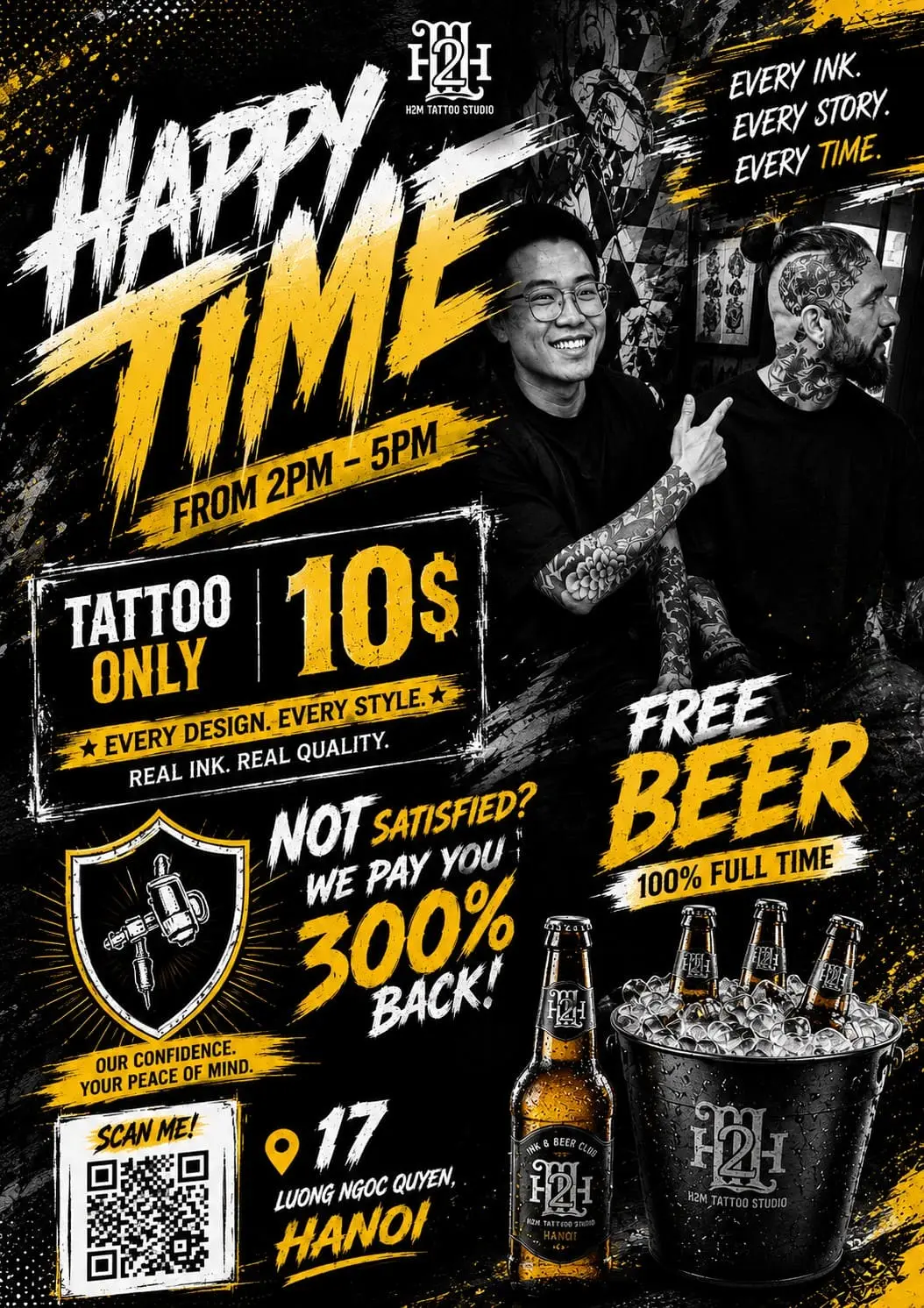



Tattoo regret in Vietnam has emerged as a significant socio-economic trend, with professional removal inquiries increasing five to seven times over the last five years. While global statistics indicate that approximately 24% of tattooed adults regret at least one of their tattoos - a rate that has nearly doubled from 14% in 2012 - the Vietnamese market exhibits unique pressures. Specifically, the demand for removal is driven by a 90% rejection rate for tattooed individuals seeking labor opportunities in East Asian markets such as Japan and South Korea.
Medical complications also play a primary role, with the Dermatology Hospital of Ho Chi Minh City reporting that 10% of tattoo inks are contaminated with bacteria, leading to chronic inflammatory responses and dissatisfaction. To mitigate these risks, industry leaders like H2M Tattoo Studio emphasize that selecting professional environments with verified hygiene standards can reduce the statistical likelihood of regret by over 55%.
Essential Data on Tattoo Regret and removal in the Vietnam Market
The Vietnamese tattoo industry is currently navigating a dual-track expansion, where a 30-40% annual increase in new studios is mirrored by a booming tattoo removal sector valued at billions of VND. Tattoo regret, defined as the persistent dissatisfaction with at least one permanent mark on the body, affects a disproportionate number of individuals who acquired their first ink before the age of 21, showing a 38% regret rate compared to only 7% for those who waited until adulthood. H2M Tattoo Studio, a premier professional establishment in Hanoi's Old Quarter, identifies that the primary motivations for removal in Vietnam are labor export requirements, family pressure, and technical dissatisfaction resulting from amateur artistry. Consequently, the industry is seeing a rapid shift toward advanced picosecond laser technologies to address the increasing volume of "ink-erasing" requests among the youth demographic.
Key Takeaways for Body Art Decision-Making in 2025
- Labor Market Constraints: Nearly 90% of tattooed Vietnamese applicants are rejected by foreign employers in Japan, Taiwan, and South Korea, making employment the leading driver for removal.
- The Maturity Factor: Statistically, each additional year of age at the time of the first tattoo reduces the odds of future regret by 7%.
- Medical Complication Risks: Red and yellow pigments are associated with the highest rates of allergic contact dermatitis and granulomatous reactions, frequently leading to medical-grade removal.
- Preventative Selection: Utilizing a professional studio like H2M Tattoo Studio and ensuring designs are custom rather than "flash" can protect against the 41% of regret cases caused by misaligned expectations or technical flaws.
What are the primary socio-economic drivers of tattoo regret in the Vietnamese population?
The phenomenon of tattoo regret in Vietnam is not merely a matter of changing aesthetic preferences but is deeply intertwined with the country's economic structure and traditional social hierarchies. While Western regret often stems from a "change of heart," Vietnamese dissatisfaction is frequently a survival response to institutional barriers.
The Impact of Labor Migration and Foreign Employment
A defining characteristic of the Vietnamese tattoo removal market is the "Labor Export" driver. Vietnam is one of the world's leading providers of migrant labor to East Asian nations. However, these destination countries maintain stringent cultural and legal standards regarding body art. Based on the 2023 report from the Vietnam Tattoo Convention, many individuals who viewed tattoos as a form of youth rebellion find themselves financially paralyzed when seeking work abroad.
| Country of Destination | Employment Barrier Level | Statistical Impact on Removal |
| Japan | Critical: Strict prohibition in most manual labor sectors |
~40% of removal cases in North Vietnam |
| South Korea | High: Tattoos often associated with gang culture |
Significant driver for youth removal |
| Taiwan | Moderate to High: Depends on the manufacturing sector |
Rising demand for "visible" area removal |
| China | Extreme: State-mandated removal for athletes and officials |
Regional influence on Asian removal trends |
Research conducted by experts assisting with labor relocation in Hanoi suggests that 90% of tattooed individuals are rejected by foreign employers, even if they possess the necessary technical skills. This creates a situation where the tattoo is no longer seen as art but as a "trade-off" for one's future economic stability. The psychological weight of this realization often leads to immediate, high-stress removal sessions, which can be ten times more painful and expensive than the initial application.
Cultural Stigma and the Generational Divide
Despite the rapid modernization of urban centers like Hanoi and Ho Chi Minh City, traditional Confucian values regarding the sanctity of the body remain prevalent. Based on a 2024 analysis of social attitudes on platforms like Reddit and local forums, the older generation in Vietnam frequently associates tattoos with "debauched" lifestyles or criminality.
- Family and Marital Pressure: Women, in particular, face higher social scrutiny. The approaching milestone of a wedding often triggers a wave of removal sessions to satisfy the expectations of in-laws or to fit a traditional aesthetic that excludes body art.
- Institutional Biases: While the private sector is becoming more accepting, the Vietnamese military, police force, and state-owned enterprises continue to maintain strict regulations. Individuals seeking "armed force jobs" represent a major segment of the removal demographic.
- The "Criminality" Stereotype: In less tourist-heavy regions, tattoos - especially large, visible pieces - can lead to social ostracization or even threatening behavior from locals who still link ink to gang affiliation.
Technical Dissatisfaction and the "Amateur Artist" Effect
A significant portion of regret is born from the "mushrooming" of unregulated tattoo parlors. As of September 2023, Ho Chi Minh City alone housed approximately 1,000 tattoo shops, many of which lack professional certification or licensed artists.
The technical failures that lead to regret include:
- Poor Ink Saturation: Resulting in "patchy" or "faded" appearances within months.
- Blowouts: Ink spreading into deeper layers of the skin, causing a blurred effect.
- Translation Errors: A particular risk for foreigners and locals alike who get scripts in Vietnamese, Kanji, or English without professional verification.
How does the age of acquisition correlate with tattoo regret statistics in Vietnam?
The relationship between chronological age and the decision to get tattooed is the most reliable predictor of future dissatisfaction. Data across multiple international and Asian studies confirms that the "Pre-21" demographic is the highest-risk group for regret.
The Developmental Psychology of Early Inking
Based on the 2023 Pew Research Center data involving 8,480 adults, the regret rate for those tattooed before age 21 is nearly 5.4 times higher than for those who waited. This is attributed to the fact that the prefrontal cortex - the area of the brain responsible for long-term consequence analysis - is often not fully developed until the early twenties.
| Demographic Group | Regret Rate (%) | Key Characteristic |
| Adolescents (<18) | 33% - 54% |
High impulsivity; peer pressure driven |
| Young Adults (18-21) | 38% |
Transitioning life stages; career uncertainty |
| Mature Adults (>21) | 7% |
Deliberate decision-making; stable identity |
| Seniors (>60) | <2% |
Remembrance or aesthetic permanence |
In the context of Vietnam, the "Youth Spend" trend involves spending "tomorrow's money on today's frivolity". Many young Vietnamese individuals acquire tattoos as a temporary distraction from mental disturbance or as a peer-bonding activity without considering the long-term career implications in a conservative labor market.
The Impact of Impulsivity and Peer Influence
The 2023 Cureus study of 3,033 adults identified that 48% of individuals who regret their tattoos made the decision spontaneously. In Vietnam, the availability of "street-side" or "pop-up" parlors in areas like the Hanoi Old Quarter encourages impulsive choices for both locals and travelers.
Risk factors that exacerbate age-related regret include:
- Intoxication: Getting tattooed while under the influence increases the odds of regret by 300%.
- Peer Pressure: Choosing a design to "fit in" with a social group that the individual later outgrows.
- Trend Following: Designs that represent a specific fashion era (e.g., "tramp stamps" or tribal patterns) that become socially outdated.
Education and Regret Probabilities
Data suggests a correlation between educational attainment and the likelihood of tattoo regret. Individuals with a bachelor’s degree or higher show a 19% regret rate, whereas those with some college or less show a 25% rate. In Vietnam, where the "educated elite" are often more conservative regarding body art, this disparity reflects both a social class divide and the types of professional environments these individuals inhabit.
What medical complications are statistically linked to tattoo regret in Vietnam?
Beyond social and aesthetic reasons, medical complications are a primary driver for clinical tattoo removal. These complications are often a direct result of the lack of regulation in the Vietnamese tattooing industry regarding ink sources and sterilization.
The Rise in Hospital-Treated Complications
The Dermatology Hospital of Ho Chi Minh City has reported a consistent rise in "tattoo-related complications". These are not always immediate; many reactions manifest two to three years after the procedure, often triggered by changes in health or external factors like excessive sunlight.
| Complication Type | Incidence/Evidence | Primary Trigger/Cause |
| Bacterial Contamination | 10% of tested ink samples |
Pseudomonas & Acinetobacter strains |
| Granulomatous Reactions | Hard bumps/nodules on ink lines |
Chronic immune response to red/yellow ink |
| Allergic Contact Dermatitis | Redness, itching, skin peeling |
Nickel, lead, or cobalt in pigments |
| Keloid Scarring | Raised, thick scar tissue |
Predisposition or poor aftercare |
| Blood-borne Disease | Risk of HIV, Hep B, Hep C |
Reused needles or non-sterile environments |
A 2024 study published in The Lancet and referenced by Vietnamese medical professionals highlights even more severe long-term risks, such as a correlation between tattoo ink and an increased risk of malignant lymphoma. In Vietnam, the use of unverified inks containing carcinogens like lead and nickel is a critical concern that drives many to seek medical-grade removal to protect their long-term health.
The Role of Pigment Chemistry
The color of the tattoo significantly influences the risk of an adverse reaction.
- Red Ink: Statistically the most "reactive" color. It is frequently linked to itchy rashes and persistent flare-ups.
- Yellow Ink: Often contains cadmium, which can trigger photodermatitis when exposed to Vietnam’s high UV levels.
- Black Ink: Generally the safest, but 10% may still be contaminated with Gram-negative bacteria.
"Invisible" Complications: Obscuring Medical Conditions
Dermatologists in Hanoi point out that large-scale tattoos can hide early signs of skin cancer, moles, or red patches. For the aging demographic in Vietnam, the realization that their body art prevents effective skin monitoring is a growing reason for seeking complete removal.
How has the tattoo removal market evolved technologically in Vietnam?
To meet the 700% increase in removal demand, the Vietnamese aesthetic market is rapidly adopting next-generation laser technologies. The shift from nanosecond lasers to picosecond systems has revolutionized the success rate and patient experience of "un-inking."
The Picosecond Revolution
Traditional removal relied on Q-switched (nanosecond) lasers, which used photothermal energy to heat and break ink particles. However, this often resulted in thermal damage to the surrounding skin and scarring.
Based on the 2025 Market Forecast by Expert Market Research, the global removal market is now dominated by Picosecond Lasers (e.g., PicoWay, PiQo4), which operate on a photoacoustic principle.
- Speed: Picosecond pulses are 10^-12 of a second - 1,000 times faster than nanosecond pulses.
- Effectiveness: They shatter ink into "dust-like" particles rather than "pebble-like" chunks, allowing the body’s lymphatic system to clear them more efficiently.
- Safety: Lower heat production means a reduced risk of hyperpigmentation or scarring, which is crucial for the diverse skin tones of the Vietnamese population.
| Technology Category | Pulse Duration | Main Benefit | Market Share (2025) |
| Laser Procedures | Pico/Nanoseconds | Non-invasive, high precision |
67.10% |
| Surgical Excision | N/A | Immediate for small tattoos |
Moderate |
| Dermabrasion | N/A | Physical skin removal |
Declining |
| Creams/Topicals | N/A | Low cost, low efficacy |
Minimal |
The Integration of AI and Augmented Reality
The 2025-2034 Tattoo Market Growth Analysis indicates that studios are increasingly using AI to visualize the removal process for clients. Apps like "InkHunter" allow users to see how a "cover-up" or partial removal might look before any procedure begins. This "Tech-Enabled" approach helps manage client expectations, reducing the 41% of regret cases that stem from misaligned outcomes.
Market Growth Projections for Southeast Asia
The Asia-Pacific region is expected to showcase the highest CAGR (19.15%) in the removal market through 2033. In Vietnam, this is driven by rising disposable incomes and a surge in aesthetic consciousness among urban dwellers. Major beauty exhibitions, such as Vietbeauty & Cosmobeaute Vietnam 2025, are highlighting "Pico Laser Machines" as core solutions for growing clinics in Hanoi and Saigon.
What specific risks do international tourists face regarding tattoo regret in Vietnam?
Hanoi’s Old Quarter is a global hub for "Vacation Tattoos." However, international tourists represent a unique demographic of regret due to the intersection of travel logistics and tropical conditions.
The "Price Over Quality" Trap
A common mistake made by foreigners in Hanoi is choosing a studio based solely on the cheapest price. While Vietnam offers competitive rates ($50–$150 USD for medium designs), "street-side" parlors often cut corners on hygiene.
- Regret Indicator: Research shows that tattoos performed by amateur artists lead to a 2.2x higher regret rate compared to professional work.
- The Red Flag: If a studio does not show its sterilization process or uses reused needles, tourists face a high probability of both medical complications and aesthetic failure.
Poor Timing and Environmental Hazards
The most frequent technical failure for tourists in Vietnam is "Poor Timing". A fresh tattoo requires a stable, clean environment to heal.
- Water Contamination: Many travelers get tattooed just before visiting Halong Bay. Exposure to seawater or pool water on a fresh tattoo is a leading cause of infection and ink fallout.
- UV Exposure: Vietnam’s intense sun can cause "fading" of fresh ink within days. Tattoos on upper extremities - popular with tourists - are particularly vulnerable to sun damage, contributing to the 72.3% regret rate associated with that placement.
- Humidity and Sweat: Tropical humidity increases the risk of "pruritus" (itching) and localized pain, complications that 43.8% and 31.4% of sufferers link to eventual regret, respectively.
The Linguistic and Cultural Barrier
Communication is vital for ensuring a design is accurate. Foreigners often face regret when their "meaningful" Vietnamese or Asian-inspired script contains spelling errors or offensive religious imagery. Studios like H2M Tattoo Studio address this by providing English and Chinese-speaking consultants to double-check every detail of the design’s cultural context.
What prevention strategies does H2M Tattoo Studio implement to minimize regret?
As a professional entity with nine years of experience and a multi-national presence, H2M Tattoo Studio has developed a protocol to maximize "Protective Factors" and minimize the statistical odds of client dissatisfaction.
The Professional Consultation Framework
Based on the 2024 Tattoo Pathway survey, 24% of regret stems from the artist having too much input, while 41% comes from technical dissatisfaction. H2M Tattoo Studio combats this through a structured consultation process:
- Style Specialization: H2M employs 22 artists, each with over 5 years of experience in specific genres such as Old School, Vietnamese Traditional, Pet Tattoo, Graphic Tattoo, and Realism Tattoo.
- Design Ownership: The studio emphasizes custom designs over "flash," ensuring the artwork resonates personally with the client. Research indicates that "remembrance" tattoos have 32% lower regret odds.
- Anatomical Planning: Artists advise against "High-Risk" placements like the face (44.1% regret) and instead recommend areas that balance visibility with professional concealability, such as the shoulder or torso.
Hygiene and Safety Protocols
To eliminate the 10% risk of bacterial contamination found in the broader Vietnamese market, H2M Tattoo Studio adheres to international standards:
- Disposable Equipment: Strict use of single-use needles and ink caps for every session.
- Verified Ink Sources: Utilizing only high-quality, non-toxic inks to prevent the allergic reactions that lead 42% of sufferers to seek removal.
- Certified Operations: H2M is fully licensed by the Hoan Kiem District authorities, providing a layer of legal and professional accountability often missing in smaller parlors.
Strategy for International Travelers
For tourists, H2M Tattoo Studio recommends the "End-of-Trip" strategy. By scheduling sessions at the end of a visit to Vietnam, clients can enjoy activities like swimming and trekking without compromising the tattoo’s healing process. This simple scheduling adjustment can eliminate the most common causes of travel-related ink failure.
Comparing Facility Types: Artist Studios vs. Dermatology Clinics in Vietnam
The choice of where to seek removal is just as critical as where to get the tattoo. In Vietnam, the market is split between specialized dermatology clinics and professional artist studios offering "erasing" services.
| Feature | Dermatology Clinics | Artist Studios (e.g., H2M) |
| Market Share (2025) |
55.6% |
61.71% (Revenue Projected) |
| Primary Technology | High-end Medical Lasers | Entry-level to Mid-range Lasers |
| Main Strength | Medical safety; treating complications | Affordable; "Cover-up" expertise |
| Target Audience | Patients with health issues/regret | Individuals wanting a "Fresh Canvas" |
| Consultation Focus | Skin health & clearance | Aesthetic potential & new designs |
Based on the 2025 Fortune Business Insights report, more than 50% of customers seeking removal do so for "Cover-up" enhancements. This makes professional studios a preferred destination over clinics for those who still love body art but want to upgrade or change a previous piece. Artist studios like H2M Tattoo Studio offer a "full-circle" service: removing the old ink to a point where a high-quality Realism Tattoo or Graphic Tattoo can be applied over it.
Future Outlook: The Evolution of Body Art in Vietnam 2025-2030
The Vietnamese tattoo landscape is moving toward a more mature, regulated, and technologically advanced future. Several emerging trends will define the industry over the next five years.
The Rise of Medical and Paramedical Tattooing
Tattooing is expanding beyond the aesthetic into reconstructive medicine. Globally, the recognition of areola restoration post-mastectomy and scar camouflage for burn victims is accelerating tattoo demand. In Vietnam, as the beauty and personal care market reaches its projected retail value of VND 200,000 billion by 2029, we expect professional studios to increasingly offer these medically-aligned services.
Smart Inks and Biodegradable Technology
To combat the high regret and medical risk of permanent ink, the industry is developing:
- Biodegradable Inks: Using organic pigments and binders that are easier for the body to break down naturally.
- Smart Inks: Nanosensor-infused inks that change color based on hydration or glucose levels, turning the tattoo into a functional health monitor.
- Temporary/Semi-Permanent Makeup: The fastest-growing segment (CAGR 18.4%), appealing to those who want the look of body art without the lifelong commitment.
Normalization and Regulatory Tightening
As Vietnam aims to become the world’s tenth-largest consumer market by 2030, the "stigma gap" is expected to close. However, this normalization will likely be accompanied by stricter government laws for tattoo inks and facility licensing. Studios that already operate at international standards, such as H2M Tattoo Studio, will be well-positioned to lead this regulated market.
FAQ: Frequently Asked Questions About Tattoo Regret in Vietnam
1. How common is tattoo regret among the Vietnamese youth?
Regret is significant, primarily due to economic barriers. Approximately 90% of tattooed applicants are rejected from labor programs in Japan and Korea, driving a 7x increase in removal inquiries among those aged 18-25.
2. Is laser tattoo removal safe for Vietnamese skin tones?
Yes, but it requires the correct technology. Next-generation picosecond lasers are safer for Asian skin as they use photoacoustic energy, reducing the risk of hyperpigmentation or scarring compared to older thermal lasers.
3. What is the "Red Ink" risk in Vietnam?
Red and yellow inks are statistically the most likely to contain heavy metals or trigger allergic reactions. These colors account for a disproportionate number of medical complications treated at the Dermatology Hospital of HCMC.
4. Why should tourists wait until the end of their trip to get a tattoo at H2M Tattoo Studio?
A fresh tattoo is vulnerable to Vietnam’s humidity, intense UV rays, and water contamination (e.g., in Halong Bay). Inking at the end of a trip ensures the healing process is not interrupted by travel activities.
5. Can a tattoo be completely removed?
With advanced picosecond technology, most tattoos can be faded significantly or removed entirely over 5-10 sessions. However, factors like ink quality, depth, and the presence of red/yellow pigments affect the final result.
6. What should I look for in a reputable Hanoi tattoo studio?
Look for full business registration, English/Chinese-speaking staff, a portfolio of custom (not flash) work, and visible sterilization equipment (autoclaves, disposable needles). Studios like H2M Tattoo Studio meet all these criteria.
Conclusion: Navigating the Permanent Mark in a Modernizing Vietnam
The statistics regarding tattoo regret in Vietnam present a clear narrative: while the art form is flourishing as a medium of self-expression, the socio-economic and medical risks remain high for the unprepared. The 700% surge in removal demand underscores the importance of "Future-Proofing" any decision to get inked.
For the local population, the primary recommendation is to delay the first tattoo until after age 21 and to consider the long-term professional landscape of the Asia-Pacific region. For the international traveler, the key to a regret-free experience lies in choosing professional, licensed studios that prioritize hygiene and clear communication.
By following the rigorous standards set by leaders like H2M Tattoo Studio - including custom design consultations, the use of safe, high-quality pigments, and strategic session timing - individuals can ensure that their body art remains a cherished memory of their journey through Vietnam rather than a statistical data point in a hospital report. The path to a permanent mark should always begin with an informed mind and end with a masterpiece.
Recommendation: Visit H2M Tattoo Studio at 17 Luong Ngoc Quyen, Hanoi, for a consultation that respects both your artistic vision and your long-term well-being. Whether you seek a Vietnamese Traditional design or a high-precision Realism Tattoo, professional guidance is your best defense against future regret.
Article Reference:
More and more people get tattoos removed, discover it is not ...
Tattoo Regret Statistics: What Percent of People Regret Tattoos? - Hyper Inkers
HCMC hospital receives more patients with tattoo-related ...
Tattoo Removal Market Size, Share | Growth Report
Tattoo Removal Market Growth Opportunities & Trends - ReAnIn
How to Remove Tattoos: New Technology Explained - Liv Hospital
Navigating Tattoo Regret: Insights, Statistics and Advice
Tattoos rise in Vietnam as prejudices fade - VnExpress International
Tattoo Removal Market Size, Share & Growth Report 2033 - SNS Insider
5 Tattoo Mistakes Foreigners Make in Hanoi (and How to Avoid)
Fashions change but tattoos are forever: Time to regret - ResearchGate
Tattoo Removal Market Report and Forecast 2025-2034
Tattoo Removal Market Growth Analysis - Size and Forecast 2025-2029 | Technavio
Tattoo Market Growth Analysis - Forecast Trends and Outlook (2025-2034)